Search no longer ends with a list of blue links. Tools like Google’s AI Overviews, ChatGPT, Gemini and Perplexity now write direct answers, and they mention only a handful of brands while doing it. This leaves many business owners asking whether their SEO still matters and what GEO adds. The purpose of this guide is to explain GEO vs SEO clearly: what each one is, where they differ, where they overlap and how generative engine optimization works in practice, so you can plan your strategy with confidence.
What SEO Does and What GEO Adds
SEO, or search engine optimization, is the work of helping your pages rank in traditional search results. You research the phrases people type, create helpful pages, make your site fast and crawlable, and earn trust through links and reviews. The reward is a position in a list, and a click when someone chooses your result.
GEO, or generative engine optimization, is a newer discipline focused on a different reward: being included, mentioned or cited inside an AI-generated answer. When someone asks “which accounting firm in Dubai handles VAT for startups?”, an AI tool may compose a short answer and name two or three firms. GEO is the effort to make sure your business is understood well enough, and trusted enough, to be one of them. If you want a plain-language introduction, our article on what GEO is and how UAE businesses can appear in AI search results is a good starting point.
It helps to think of GEO as an extension of SEO rather than a replacement. Google states in its guidance on AI features and your website that the same foundational SEO practices apply to its AI experiences. In other words, a site that is not crawlable, helpful and trustworthy will struggle in both worlds.
How Generative Engine Optimization Works
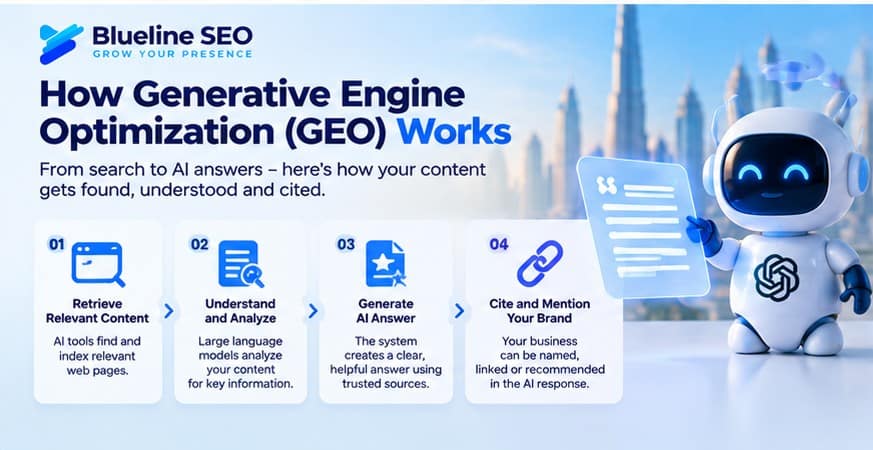
To understand GEO, you need a simple picture of how AI answers are built. Large language models, described in this overview of large language models, learn patterns from huge amounts of text. Many AI search tools also use a method called retrieval-augmented generation: the system first retrieves relevant pages from the web or an index, then uses them as source material to write the answer.
That second step is where GEO has influence. Your content can only be used if it is retrievable, meaning it is crawlable and indexed, and usable, meaning it is clear enough that the system can lift a fact or explanation from it with confidence. Pages that state things directly, define terms, give specific facts and show who is behind the information tend to be easier to use than pages full of vague marketing language.
Your wider reputation also matters. AI systems learn about brands from many places: your website, directories, reviews, news mentions and professional profiles. If those sources describe your business consistently, the system builds a stronger picture of who you are and what you do. Directories such as Yellow Pages UAE and Connect.ae, official business bodies such as Dubai Chambers, and business media such as Gulf Business and Arabian Business are the kinds of sources that can reinforce your brand picture. This is why GEO work stretches beyond your own website and includes building local citations in the UAE and keeping your business details consistent everywhere.
Key Differences Between GEO and SEO
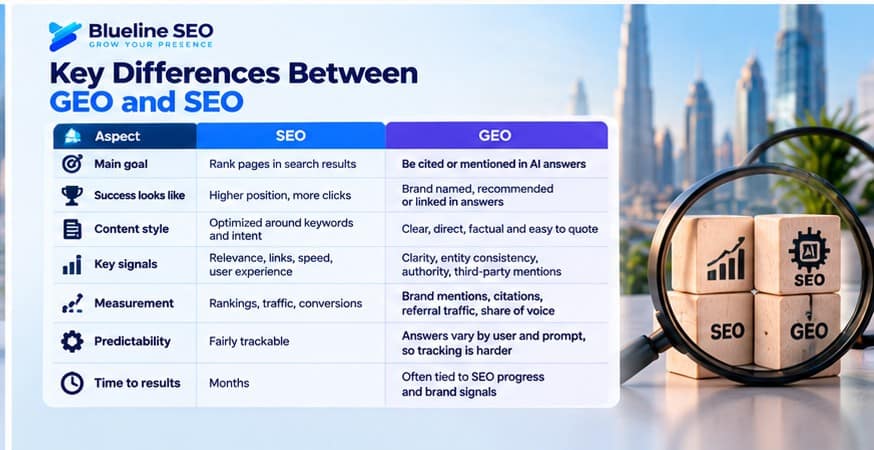
The two disciplines share most of their foundations, but they aim at different outcomes and are judged differently. The table summarises the main contrasts.
| Aspect | SEO | GEO |
|---|---|---|
| Main goal | Rank pages in search results | Be cited or mentioned in AI answers |
| Success looks like | Higher positions and more clicks | Brand named, recommended, or linked in answers |
| Content style | Optimized around keywords and search intent | Clear, direct, factual, and easy to quote |
| Key signals | Relevance, backlinks, page speed, and user experience | Clarity, entity consistency, authority, and third-party mentions |
| Measurement | Rankings, organic traffic, and conversions | Brand mentions, citations, referral traffic, and share of voice |
| Predictability | Relatively easy to track | Harder to track because answers vary by user and prompt |
| Time to results | Often takes months | Varies and may depend on SEO progress and brand authority |
One important difference sits in the last rows. Traditional rankings are relatively stable and easy to check, while AI answers can change from one person or one question to the next. That means GEO reporting relies on sampling many prompts over time rather than looking at one fixed position.
Where the Two Overlap
Despite the differences, strong SEO is the single best preparation for GEO. Both need helpful content written for people, a technically healthy website, clear structure and real authority. If your pages are slow, thin or poorly organised, no AI-specific tactic will rescue them.
The overlap also explains why businesses with a long-term SEO programme often adapt well to AI search. They already have indexed pages, a reputation, reviews and topical depth. If you are starting from zero, begin with the fundamentals explained in how to rank a new website on Google in the UAE, then layer GEO improvements on top. Many of the most common problems, such as blocked pages, duplicate content and weak titles, appear in our list of the top SEO mistakes in UAE businesses, and fixing them helps both goals.
What GEO Looks Like in Practice for UAE Businesses
In the UAE, GEO has a few local angles. Customers search in English and Arabic, so content in both languages, written naturally rather than translated word for word, gives AI systems more material to understand your business. Location signals matter too: clear service areas, consistent addresses and an optimised Google Business Profile help systems connect your brand with places like Dubai, Abu Dhabi or Sharjah.
On the content side, practical GEO work means answering real customer questions in plain language near the top of a page, adding concise definitions, using tables and FAQs where they genuinely help, and showing expertise through named authors, case studies and original details. It also means keeping your website technically sound, which is why many companies pair GEO with web development improvements. If you want a specialist team to guide this process, you can look at Blueline’s GEO services and SEO services, including SEO in Dubai.
Which Should You Prioritise?
For most businesses the honest answer is to invest in SEO first and add GEO as a layer on top. SEO still drives the majority of measurable traffic for many companies, and it creates the content and authority that GEO depends on. If you are already ranking well, GEO is a natural next step to protect and extend your visibility as AI answers grow.
Be cautious about anyone who promises guaranteed AI mentions. No one controls what an AI tool says, and results build gradually, much like SEO does. Our guide on how long SEO takes to work in the UAE sets realistic expectations that apply here too, and a comparison of SEO vs Google Ads in Dubai can help you balance organic work with paid channels. You can also review case studies to see how long-term work plays out, and follow marketing trade media such as Campaign Middle East to see how agencies and brands in the region are approaching AI search.
You can also review case studies to see how long-term work plays out.
Frequently Asked Questions
What is the main difference between GEO and SEO?
SEO aims to rank pages in search results, while GEO aims to have your brand cited or mentioned inside AI-generated answers.
Does GEO replace SEO?
No. GEO builds on SEO. Crawlable, helpful, trustworthy pages are needed for both.
How does generative engine optimization work?
AI tools retrieve relevant content and use it to write answers. GEO makes your content clear, consistent and authoritative so it is easier to retrieve and cite.
Can I measure GEO results?
Partly. You can track brand mentions, citations and referral traffic, but AI answers vary, so measurement relies on sampling over time.
Is GEO important for small UAE businesses?
Yes, especially for local services, where people ask AI tools for recommendations. Strong local signals and clear content help.
How long does GEO take?
There is no fixed timeline. Progress is gradual and usually follows SEO and brand-building work over several months.
Conclusion
The GEO vs SEO question is less about choosing a winner and more about understanding how they work together. SEO earns you rankings and traffic, while GEO helps AI systems understand, trust and recommend your brand. Build the foundation first, add clear and authoritative content, keep your brand signals consistent and measure honestly. To plan this for your business, contact the BlueLine SEO team.