When people ask an AI tool a question, it reads many sources, then writes one answer. If your content is confusing, vague or hard to verify, it is unlikely to be used. The purpose of this guide is to show you how to approach content optimization for AI search in a practical way, focusing on three areas that matter most: how you structure your content, how you build clear entities and how you demonstrate E-E-A-T. By the end, you will know how to review your existing pages and write new ones that AI systems and human readers can both trust.
Why AI Search Changes How You Write
Traditional SEO taught many writers to build a page around a keyword. AI search adds a second reader to think about: a system that retrieves passages and uses them to compose an answer. This system works best when a page is easy to scan, makes clear statements, and shows where its information comes from. If you want the foundation, our article on what GEO is and how UAE businesses can appear in AI search results explains the broader idea. For regional context on how AI is changing business and search, TahawulTech is a useful publication to follow.
The good news is that you do not need a separate set of tricks. Google’s own guidance on creating helpful, reliable, people-first content remains the best baseline, and its page on AI features and your website confirms that standard SEO practices apply there as well. What changes is the level of clarity. Content that was merely acceptable for rankings may be too vague to be quoted in an answer, so the standard for precision rises.
Structure: Make Every Page Easy to Understand and Quote
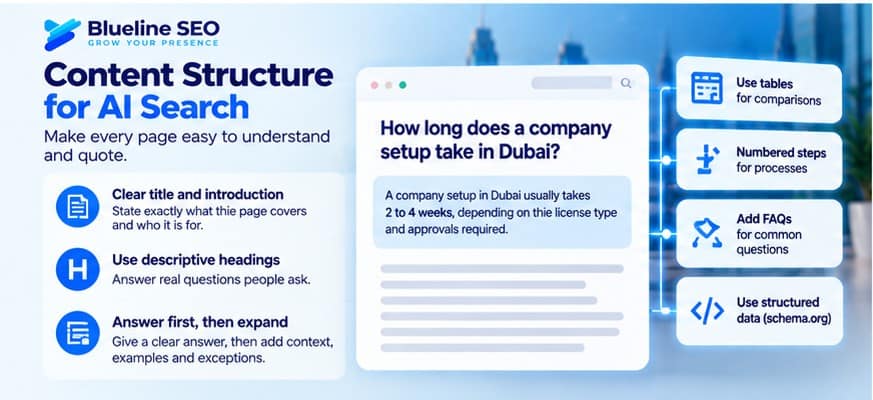
Structure is how your page communicates its meaning before anyone reads a full paragraph. A clear structure begins with a title and opening that state exactly what the page covers and who it is for. Headings should describe the content beneath them in plain language, ideally phrased the way people actually ask questions. A heading like “How long does a company setup take in Dubai?” is more useful than a creative but unclear one.
Directly under such a heading, give the answer in the first sentence or two, then expand with context, examples and exceptions. This pattern, often called answer-first writing, helps both readers and AI systems because the key fact is easy to find and lift. Keep paragraphs focused on one idea, define technical terms the first time you use them and avoid filler introductions that delay the point.
Format matters too, but should serve the content. Tables suit comparisons, numbered steps suit processes and short FAQ sections suit common follow-up questions. Overusing lists can fragment explanations, so keep full paragraphs where reasoning is needed. Technical structure supports this: a clean heading hierarchy, descriptive image text, fast loading and crawlable pages. You can also add structured data from schema.org to describe your organisation, articles, products and FAQs in a machine-readable way. A well-built site makes all of this easier, which is why content strategy often goes hand in hand with web development.
Entities: Help Machines Understand Who and What You Are
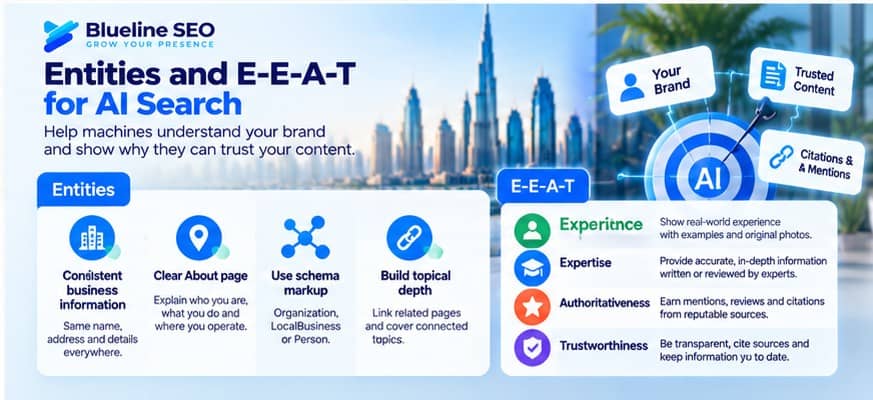
An entity is a distinct thing that search systems can identify: a company, person, product, place, or concept. Search engines and AI tools build connections between entities, often described as a knowledge graph. When your brand is clearly defined as an entity, with a consistent name, description, location, services, and relationships, systems can connect your content with the right questions.
Building a strong entity starts with consistency. Use the same business name, address, and description on your website, Google Business Profile, social profiles, and directories such as Yellow Pages UAE, UAE Business, and ATN Info. Where your business is eligible, official listings with Dubai Chambers add another trusted reference point. Create a clear About page that explains who you are, what you do, where you operate, and who leads the business. Use schema markup for Organization, LocalBusiness or Person where relevant, and link to your official profiles so systems can confirm they belong together.
Entities also apply to your topics. If you write about SEO, mention related concepts naturally, such as technical SEO, local search and reviews, and explain how they connect. Link related pages together so your site shows topical depth, rather than isolated articles. For UAE businesses, location entities matter: clearly connect your services to Dubai, Abu Dhabi or other areas, and keep listings accurate through steps such as those in our Google Business Profile optimization checklist and guide to local citations in the UAE. If your business is local, what local SEO is is worth reading too.
E-E-A-T: Show Experience, Expertise, Authority and Trust
E-E-A-T stands for Experience, Expertise, Authoritativeness and Trustworthiness. It comes from Google’s quality guidelines, and while it is not a single ranking switch, it describes the qualities that human evaluators look for and that Google’s systems try to reward. In AI search, where a tool must decide which sources are safe to rely on, these signals are especially valuable.
Experience means showing that real people have actually done what you describe. Use original photos, project details, practical lessons, and honest limitations. Expertise means the content is accurate and written by someone who knows the subject, so include author names, short bios, and credentials where relevant. Authoritativeness is about reputation: mentions, links and references from respected sources in your industry, such as expert commentary or features in business media like Arabian Business and Gulf Business, or genuine corporate announcements on Zawya. Trust is the foundation of all four: clear contact details, transparent business information, secure pages, accurate claims and sources for important facts.
Sensitive topics such as health, finance, and legal advice need extra care, because errors can harm people. Cite reliable sources, update content regularly, and avoid exaggerated claims. Real evidence builds trust, so publish case studies and customer reviews, and let readers see case studies that prove your results.
A Practical Checklist You Can Use Today
The table below turns these ideas into steps you can apply to any page.
| Area | What to Do | Why It Helps AI and Readers |
| Opening | State the topic, audience and answer early | Makes the page easy to quote |
| Headings | Use clear, question-style or descriptive headings | Signals what each section covers |
| Answers | Lead with the direct answer, then add detail | Supports extraction and trust |
| Formats | Use tables, steps and FAQs where they fit | Organises comparisons and processes |
| Entities | Keep name, address and descriptions consistent | Builds a clear brand identity |
| Schema | Add relevant structured data | Gives machines explicit context |
| E-E-A-T | Show authors, evidence, case studies, and sources | Builds credibility |
| Freshness | Update facts and dates regularly | Keeps information reliable |
| Internal links | Connect related pages | Shows topic depth |
Measuring Progress and Avoiding Common Mistakes
Measuring AI visibility is less precise than tracking rankings, because answers vary by person and question. A sensible approach is to track a set of important questions regularly, note whether your brand is mentioned or cited, and combine that with organic traffic, branded searches and referral visits in your analytics. Treat the results as direction, not exact measurement.
Common mistakes include writing generic content that could belong to any company, hiding the answer under long introductions, publishing AI-generated text without checking facts or adding real expertise, ignoring technical health and letting information go out of date. Many of these overlap with the top SEO mistakes in UAE businesses, so fixing them benefits all channels. Remember that results take time, as explained in how long SEO takes to work in the UAE. For hands-on support, explore Blueline’s GEO services and SEO services.
Frequently Asked Questions
What is content optimization for AI search?
It is the practice of writing and structuring content so AI tools can easily understand, trust and cite it in generated answers.
Is optimizing for AI search different from SEO?
It builds on SEO. The same helpful, crawlable content applies, but AI search rewards extra clarity, direct answers and strong brand signals.
What is an entity in SEO?
An entity is a clearly defined thing, such as a business, person, product or place, that search systems can identify and connect with other information.
Is E-E-A-T a ranking factor?
It is not a single ranking factor. It is a framework describing quality signals, such as experience, expertise, authority, and trust, that Google’s systems aim to reward.
Does schema markup help AI search?
It can help by giving machines explicit information about your content, though it does not guarantee citations. Clear writing still comes first.
How often should I update content?
Review important pages regularly, especially when facts, prices, laws or services change, so information stays accurate.
Conclusion
Strong content optimization for AI search comes down to three habits: structure pages so answers are easy to find, define your business clearly as an entity, and prove your credibility through E-E-A-T. None of this replaces good SEO. It sharpens it. Apply the checklist to your most important pages first, then expand. To get expert help with your content strategy, contact the BlueLine SEO team.